I've been arguing again at WUWT, eg here and here. The context is a campaign being waged to try to shift responsibility for coming US electricity price rises away from the Trump administration, to other scapegoats - while still blaming Biden, of course. The talking point seems to come from the White House. It is that you can blame the blue states, because their climate policies make electricity prices higher than red states.
Well, it's true that generally prices are higher in blue states - WUWT posted this map to make the point:
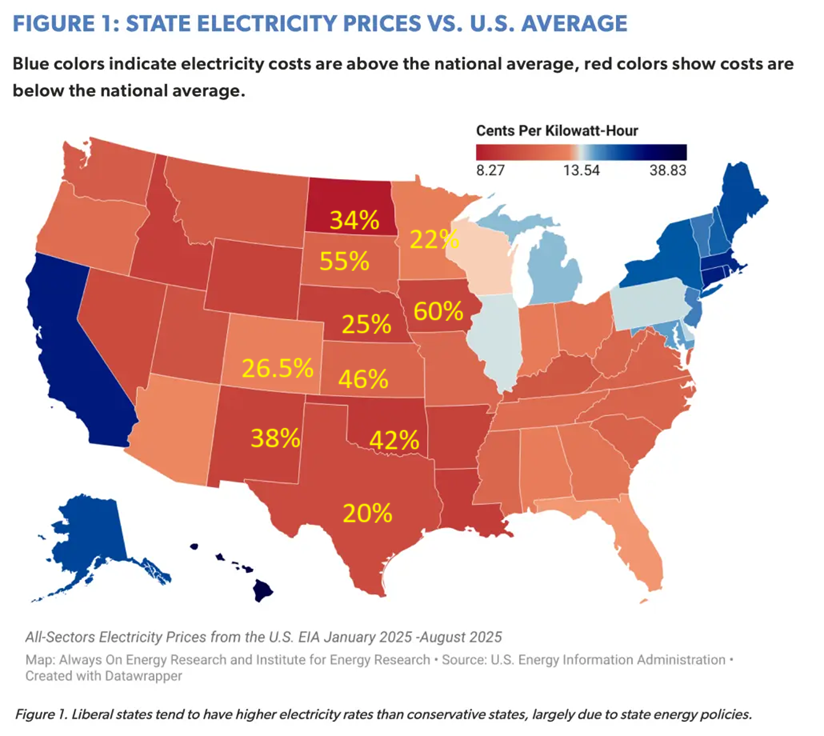
But I added in yellow the percentage of generation performed by wind in the top ten wind states. They are mostly red states, and have quite low electricity prices. So it isn't use of wind, at least, that makes the difference.
A commenter, Mark BLR, showed a graph of price versus wind use which makes the point more comprehensively. My version is here:
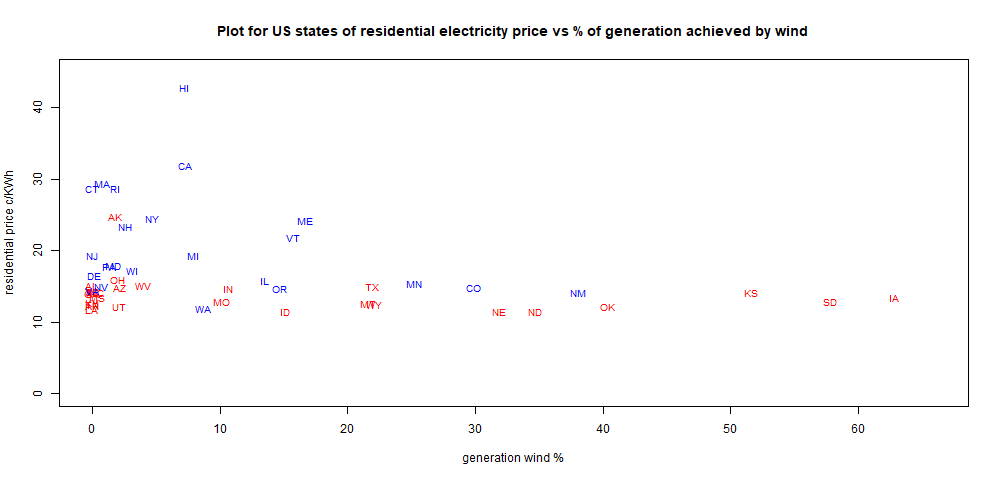
States with high wind use, red or blue (but mostly red) have prices pretty much at the minimum.


 Posts
Posts


You're right, the state's political leaning predicts price much better than wind generation percent.
ReplyDeleteCan you explain how the mostly D-leaning states drain the customer's wallet? Crony capitalism? Taxes? Other government control?
I don't know why. In California, PGE's huge civil liability for wildfires must be a factor.
ReplyDeleteNick: Your map above is almost certainly misleading, because the retail price of electricity from wind doesn't cover the true cost of producing electricity from wind. For example, there is the Federal Renewable Energy Tax Credit which - if I understand correctly - once paid wind generators $0.24 for every KW-h of electricity generated for the first ten years (a price that rose with inflation). Wind turbines last 20-25 years, so more than half of the cost of wind power could be being paid by the federal government. Warren Buffett, who owns 40% of the wind turbines in Iowa (a former blue state), has candidly admitted at his famous annual meetings for shareholders ("Woodstock for Capitalists") that investing in wind turbines wouldn't make sense without those tax credits. Wind generators like Buffett also have long-term purchase agreements with companies like Google (that claim to run 100% on electricity from renewable sources) that guarantee a market for his electricity, even when Google's demand is actually being met by other generators when the wind isn't blowing.
ReplyDeleteTexas spent $7B to build an enormous transmission line to bring electricity from wind-rich West Texas to populous eastern Texas. Transmission Service Charges amount to 25-40% of the average Texas bill, but may may not be included in the above "residential price". Fossil fuel generation is usually sited relatively near customers.
I'm not an expert on all of the ways our taxes are subsidizing electricity from both renewable and non-renewable generators. Subsidies for bringing electricity to rural areas go back to the 1930s. I was struck by an interview with the owner of the first wind farm in Alberta, who was asked why he hadn't replaced his mostly non-operational turbines with new, more efficient ones - given his existing investment in land and other infrastructure. His answer: No one around here wants to buy electricity when the wind is blowing strongly. He was waiting for the government to guarantee him a market for his electricity even when there was no demand for it. Some plans for achieving zero CO2 emissions call for building 3-fold more wind turbines than needed to meet average demand, so that demand can be met when the wind is blowing weakly. That would waste 2/3rds of output - even with the added cost of significant storage. Given that the law of supply and demand determines the cost of goods in the real world, we can be sure the levelized cost of generation from intermittent sources is an under-estimate of its real value compared with dispatchable generators, but it isn't easy to say how much.
Just dropped by to use some of the resources you provide. Thanks so much. Frank
PS. I presume you've seen that Science of Doom is now publishing on Substack.
Hi Frank,
ReplyDelete"Your map above is almost certainly misleading"
It isn't my map - as I said, it is from WUWT, but was doing the rounds in conservative circls - even Trump referred to it. I just added the wind energy fraction data.
You've probably seen commenter michel taking me to task at WUWT on price vs cost. My view is that price is much better known than cost, and also represents the way costs impact the community. And they can't get too far out of line if firms are to survive. If there is a big input of subsidy, that can be tracked. But it is unlikely that the higher use of wind in the prairies is due to higher subsidies. These are solid red states.
It's true that with fully developed wind and solar there will be excess capacity, and frequent gluts, leading to "waste". But there is virtually no marginal cost of production - no fuel cost. The issue that has to be sorted out is a fair way of sharing access to the market. And in the longer term, we'll find a use for that excess.